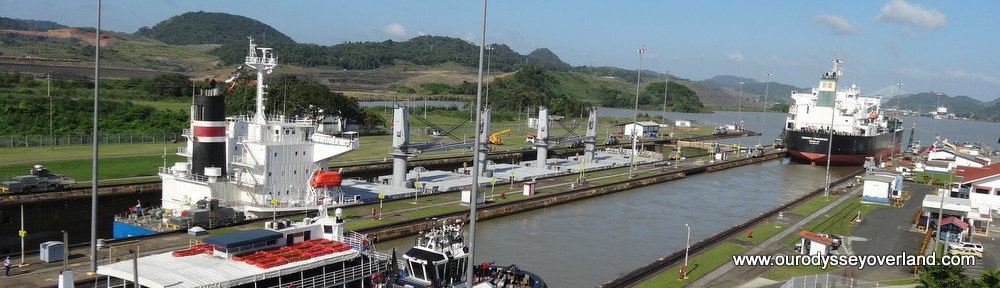

Panama represents a crossroads for many but consider the irony: you cannot cross between North and South America on land, yet ships can pass between the Atlantic and Pacific Oceans through land. How can this be?
The gap
Anyone completing an overland journey of the Americas faces one obstacle: a 100 kilometre gap in the road between Yaviza, Panama and Turbo, Colombia. In this day and age, it may be hard to believe that a major artery to connect North to South America remains incomplete, but political and engineering difficulties, along with environmental and social concerns, have stopped all efforts to complete the road.
Called the Darien Gap, overlanders must choose between flying over it and sailing around it. Both options put an equal and fairly serious dent in the trip budget. Our preference for the slow, scenic route directed us to the Stahlratte (Steel Rat), a two-mast German schooner, able to transport 19 motorcycles and their riders per sailing. The three night journey from Cartagena, Colombia to Cartí, Panama also included some downtime in the gorgeous San Blas islands.
At Cartí, the crew dropped us onto a tiny wharf in the middle of the nowhere. It was linked to the Interamericana Highway by a rollercoaster of a road through the jungle. Although the road was good asphalt, Matt considers it our hardest ride to date: the inclines and declines were the steepest we’ve come across. Having crossed the Andes seven times in South America, the difficulty of this road was unexpected.
This was the closest we would get to the Darien and the ride gave us a minuscule taste of the challenges of its terrain. Intrepid riders have attempted to cross the gap on motorbike – some have made it and others have given up, abandoning their motorcycle to continue on foot or by boat. Bob Webb’s written account of his four attempts to ride through in the 1970s shows photos of survey stakes marking where a highway would go, yet it remains unbuilt.
The ditch
It was a very different story when we went to visit the Panama Canal (aka the big ditch). Political and engineering difficulties, along with environmental and social concerns, did not stop the forging of this route across the continental divide, thus linking the Atlantic and Pacific oceans. It seems that nothing is impossible once the operational needs of the U.S. Navy are considered (at least that’s what we heard!).
At first, the French attempted to build a sea-level canal but the project eventually went bankrupt due to the cost and difficulties of construction. Clearing and maintaining a path through the unstable mountains of the continental divide appeared impossible, plus tropical disease and accidents took a great toll on the workforce (an estimated 22,000 people died).
The Americans took over the project but abandoned the idea of a sea-level canal. Instead they chose a lock system that would raise and lower ships from a large inland lake, 26 metres above sea level. They still had to excavate a lot of earth during the construction – they say it would have been enough to build 60 Great Pyramids!
You also cannot fail to be impressed by the scale of the locks: each lock chamber is big enough to fit a ship the size of the Titanic and there are a total of 12 chambers in the canal. Yet the transit itself is a remarkably quiet and slick process. I guess when the average transit toll is US$54,000, time truly is money. Ships have been known to pay as much as US$375,000 to jump the transit queue. We can understand why alternative solutions, like Peru’s Interoceanic Highway or the proposed canal in Nicaragua, are being sought.
Thankfully two bridges have been built over the canal allowing vehicles to cross this unnatural gap in the road. For us, it was a thrill to ride over the Centennial Bridge and look down upon the section of the canal that was so difficult to construct.
Given the history of the Panama Canal, it seems that if the economic or political benefits were ever persuasive enough, a road would be built through the Darien Gap, regardless of the wider costs. Panama would then become a true crossroads, but I’m not certain that I want that day to come.
Posted by Fiona
In all, we spent three weeks in Panama and found it to be a huge cultural shift from South America! Learn more about what we saw through our photos here. More Panama photos are in our online gallery here.


 Our Odyssey Overland
Hi Fi Thank you for the history. It is intriguing. Political, geographical and economic interests certainly play a large part in such an undertaking as joining two continents by road. It does seem as if the will is not yet there. Maybe the cultural divide is just too great. How does Panamanian culture differ fro that in SA. Is it far more americanised?
Safe travel. Love. Bob and Yvonne
Sent from my iPad
>
Hi Yvonne
Thanks for your comment! It certainly seemed more Americanised – mega shopping malls, major fast food chains and lots of urban 4WDs!.Away from the Panamericana and Panama City, this was more diluted. Of the places we went to, only the San Blas islands had a strong indigenous culture. I think the Darien’s indigenous communities would also.
Love Fi