
As we approached the World Heritage Bolivian city of Potosí, all we saw was a dominating and unnaturally stark mountain with a city at its feet. In the cold thin air of the inhospitable Andes ranges, it is an unlikely location for what was once the largest and wealthiest city of the Americas.
When the Spanish first arrived in the 1540’s they saw the same mountain, but in their eyes it was a mountain of money. Cerro Rico (Rich Mountain), also known as the “mountain that eats men alive”, contained an inconceivable amount of silver thus setting Potosí’s great rise and fall. I had to go inside for a look.
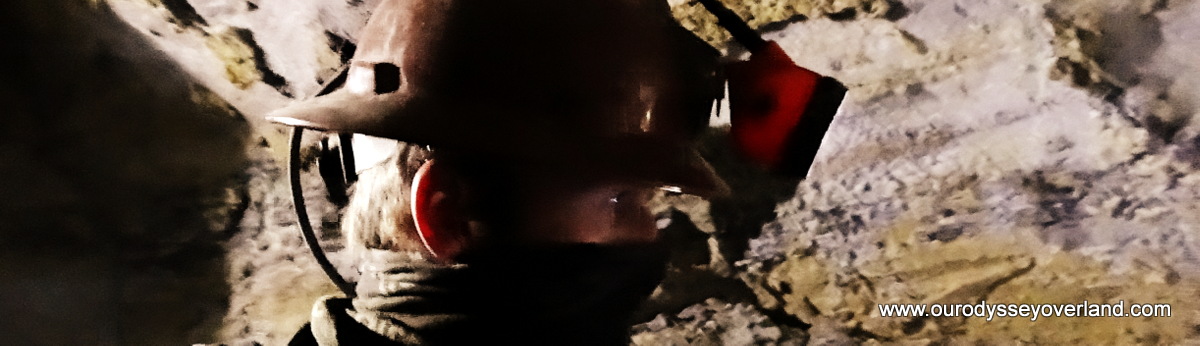
After signing my risk disclaimer and donning a helmet, overalls and gumboots, I entered the mines (Fiona opted out having done this eight years before). It was a dangerous place and the already thin air became stale, thick with dust and much harder to breath. One girl was panic stricken when she discovered the guide didn’t have an emergency oxygen tank in his back-pack. But for the miners of Potosí, these issues are the least of their problems. Poisonous gasses (including arsenic, silica dust and asbestos), dynamite blasts, rock falls and runaway trolleys – to name a few hazards – have all lead to as many as eight million deaths over three centuries of Spanish rule. This is a figure I find difficult to fathom, but has been quoted in a number of places.
Back then, the need for manpower was enormous. Indigenous communities, already being wiped out by European diseases, were forced to work in the mines. They were joined by countless African slaves shipped in to help meet the demand. But the Spanish discovered a secret weapon: the traditional indigenous practice of chewing coca leaves was originally declared evil by the Catholic Church and banned. This decision was later reversed when they realised that it increased miners’ productivity. It even became mandatory for miners to chew it. In this way the Spanish were able to keep miners underground for six or more months at a time and have them work 48 hour shifts. If they survived this, their eyes had to be covered for weeks when they came out into the light again.
The miners turned to religion to help them survive. Outside the mines they prayed to God, the new one taught to them by the Spanish, but underground in the mines they sought protection and success from Pachamama (Mother Earth) and Tio (the Andean Devil). We were led to one of the many large statues of Tio deep in the mine. The miners offer him cigarettes and coca leaves. They also offer him pure alcohol (96%) and to show their devotion, they drink it too. It tastes foul, but I found the second mouthful wasn’t as bad.
Today, the government mines have long since closed down, leaving only small companies and mining cooperatives to scavenge for what little mineral is left. Whilst miners can earn a bit more than the minimum wage, they usually die of silicosis pneumonia within 10-15 years. For the injured and terminally ill, they often have no choice but to continue working. For the widows and families left behind, the children have often taken the place of their father in the mines. In 2010, it was estimated that 1,000 children work in the mines. We were deeply moved by the story of a 14 year old boy who had worked as a miner for four years, as depicted in the documentary “The Devil’s Miner”.
The city retains many impressive colonial buildings but seems to be struggling to survive. It doesn’t seem right that a city (and a country) which possessed such enormous natural wealth that was exploited by the Spanish to fund their empire for three centuries, is now South America’s poorest country.
Now, the risk of this mine collapsing is very real. This mountain has been continually mined for nearly 500 years and today has over 4,000 tonnes of earth removed from it each day. It was a relief getting out and I was exhausted and aching from the all the crawling and crouching through the low tunnels. It was a sobering experience, but I agree with Fiona: one visit is enough. Luckily for us we have that choice.
Posted by Matt
More of the story is told in the photos and captions below. Extra photos are in our gallery.


 Our Odyssey Overland
Intriguing but horrifying. Devastating for those trying to making a living in such an environment.
I couldn´t agree more!!
Great stuff Matt. So much we don’t know about the world around us.Thanks for opening our eyes to this.
Thanks Fiona – we are learning new things every day!