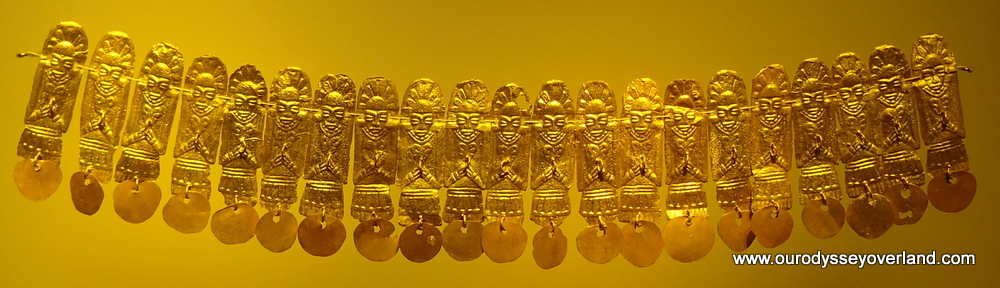

The European quest for the legendary El Dorado prompted the exploration of the furthest reaches of the New World, including the first known navigation of the Amazon River. Luckily for us, we just had to pop into the Museo del Oro (Gold Museum) in Bogotá to find it.
Whilst Colombia’s collection of pre-Hispanic gold artefacts is vast enough to fill a museum in every major town in this country, the largest collection is kept in Bogotá. The sheer scale, beauty, variety and exquisite craftsmanship on display kept us captivated for most of the day.
The museum’s centrepiece is a miniature raft cast into a single gold piece. It depicts an indigenous inauguration ceremony, upon which the legend of El Dorado is based. In this ceremony, the new chief was completely covered in gold powder and cast out on a raft on a lake (later identified as Guatavita Lake, near Bogotá), where he threw offerings of gold and emeralds into the water and requested a renewal of life from the gods. The gold offerings represented the fertilising energy of the Father Sun whilst the lake represented the womb of the Mother Earth. When he returned to the shore, he was heralded as the new ruler with music and dance.
The Spanish referred to this golden chief as El Dorado, meaning “the gilded one”. The wealth of gold found by the Spanish amongst the native tribes along the continent’s northern coast convinced them there was a place of great wealth somewhere in the interior, and so the search for this El Dorado began.
At Guatavita Lake, several attempts have been made to unearth the assumed stockpile of treasure lying at the bottom with marginal success. For example, the lake was completely drained in 1898, however the muddy bed hardened like concrete in the sun and could not be investigated! We understand that it is now illegal to drain the lake, so perhaps Mother Earth will be allowed to keep these riches.
There was so much gold on display at the museum, we wondered how the Spanish and other pirates, in their ruthless pursuit, managed not to find any of it. On the other hand, this may just represent the little that remains, giving a vast scale to the quantities of priceless objects that have long since been melted down and lost forever. We also wonder how many more treasures are yet to be found here. Colombia has little spare cash to support archaeological digs and conservation, so these treasures may remain hidden for a long time to come.
A selection of photos from the Museo del Oro are below:


Here are some photos of our journey from outside of Medellin, to Bogotá and then up to the Caribbean coast:


More photos from this section of our journey are available here.
 Our Odyssey Overland