
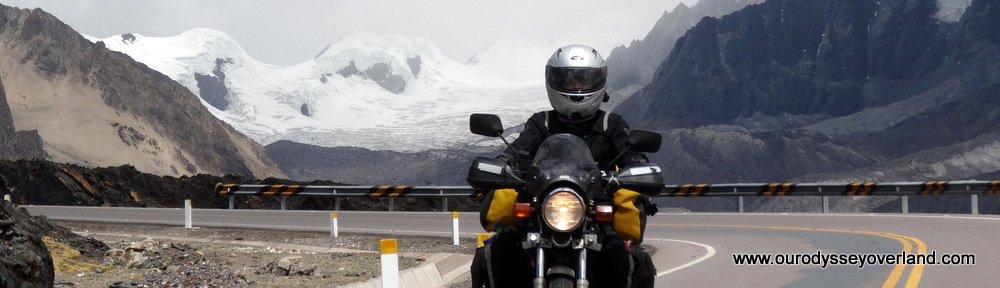
When you hear about a recently opened, beautifully paved road that goes from Peru’s jungle to its coast, it is impossible to resist. We didn’t know at the time, but this road – the Interoceanic Highway – had been dubbed by the Wall Street Journal as South America’s Route 66.
We only rode 1000 kilometres of the highway, from the Amazonian city of Puerto Maldonado, through the Andean mountain city of Cusco and down through the Nazca desert to the Peruvian coast. Along the way, we were astounded by the variety of ecosystems the road traversed. It was the best geography lesson anyone could hope for.
However, the road was intended to be more than simply a scenic drive for tourists. Linking Brazil’s Atlantic port near Sao Paulo to Peru’s Pacific ports, this long ribbon of bitumen was recently completed to provide trade access to lucrative Asian markets; an alternative to the Panama Canal. As such, we expected the road to be laden with cargo trucks, but we found it largely empty and a dream to ride. It begged the question: why isn’t this multi-billion dollar project being used? We soon found out.
En route to the coast, we had to climb five mountain passes in excess of 4000m each, equating to more than 9,600m of climbing and hundreds of tight hairpin bends. One author has pointed out that this climb is greater than an ascent of Everest. He estimated that 1,500 lorries would be required to carry the same amount of grain as the largest vessel able to pass through the Panama canal. The mental image of this chain of lorries chugging up and down Everest, before the grain is even shipped overseas, is ludicrous. Even on motorbikes, we found that the journey demanded concentration, low gears and time (it took us five days of riding). It is not surprising that carrying exports via barge along the Amazonian river system and then through the Panama is more effective in energy and dollar cost.
The fact that the road blazes right through the Amazonian rainforest has made it a subject of controversy. Throughout our ride, we saw evidence of Pachamama (Mother Earth) trying to reclaim her land. An extensive retaining wall system tried to keep her at bay, but rockfalls, landslides and buckling of the road surface was evidence that she will not give up easily. Teams of workers were dotted along the road trying to fix these issues, as well as burn and cut back the vegetation that was slowly creeping back along the roadside.
Yet, along the lowlands of the rainforest, it was clear to us that the vegetation was not growing back. The road has triggered a population movement, with an estimated 200 people from poor mountain communities arriving per day to resettle here in the hope of finding work and a better life. Tumbledown settlements are spreading along the highway and more forest is being cleared for housing and agriculture. Some new settlers are turning to gold mining, largely unregulated, to earn a living. They use mercury to separate the gold, which ends up in the area’s precious river systems and poisons them.
Once in the Andes, the highway hits the Sacred Valley or Peru’s tourism central. It goes right through the middle of Cusco, where horns blare, tempers flare and speeds drop to 10km per hour. This city is choked dealing with local traffic, let alone an international trade route.
West of Cusco, we noticed that the road became busier with both tourist and truck traffic. Clearly the paving of this section was welcomed by tourism operators who now have a fast land-link from Lima to Cusco. Few westerners stopped en route: it seemed to be only us and some intrepid Europeans who were tackling the route on bicycles – true legends! Truck traffic appeared to be servicing the local townships rather than carrying goods for export. These aficionados, resigned to the demands of the road, were content to slowly grind their way up and down the mountains and valleys.
The highway is certainly worthy of the title “South America’s route 66”, it was nothing short of spectacular, but its development has so far come at an immense, as yet untold, cost. We have to wonder: was it worth it?
Some of our photos are shown below. More photos and and stories within the captions are available by clicking here.


 Our Odyssey Overland
Not sure how you will settle at Tempe after this adventure – amazing stuff and thanks for sharing.
This is a great education lesson – fascinating reading. I’m learning so much.