
We had been cold for way too long so it was time to descend to the jungle and warm our bones. A two day ride took us from the barren high plains of the Bolivian altiplano, down through a misty cloud forest and into the verdant Amazon basin. It was pure joy to ride unencumbered by layers upon layers of warm riding gear.
Our destination was Villa Tunari where I hoped to see an old friend. Unfortunately I was too late.
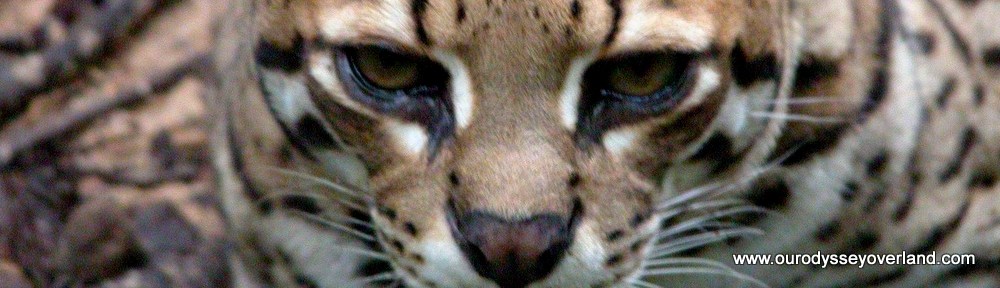
Eight years ago, I came to this village to volunteer at a wildlife refuge called Inti Wari Yasi. I was given the job of caring for an ocelot called Boudecia, who had been rescued from a family that had kept her as a pet for five years. She had lived in a small cage and was given little food so her growth had been stunted. Her frame was more like that of a large domestic cat with over-sized paws and, for me, it was love at first sight.
Looking after her was a full time job and my days revolved around her needs, the most important being a twice daily walk in the park’s jungle grounds. It was a surreal experience, walking an ocelot through the jungle. Although she was kept on a lead, she controlled where we went: her little body could squeeze under logs, jump over boulders and break through vegetation that my body could not. It was a job to keep up with her and retain my hold of her lead along this obstacle course. She was a magnificent animal.
Upon my return visit, I was sad to learn that Boudecia had died a few years ago. Inti Wari Yassi, however, still attracts an international volunteer crew to look after a menagerie of rescued animals and has expanded to own two more remote plots of land for the rehabilitation of big cats. We strolled through the park, enjoyed the company of some current residents and were treated to lunch by the park’s founder, Nina.
After five days of warm jungle walks and relaxation, we felt ready to tackle the heights again so we began the ascent to La Paz. The route would take us from our jungle altitude of 309m, up over a high mountain pass of 4,490m and back to 3,360m in La Paz.
On the way up, we stopped in Cochabamba to fix a problem my bike had been having since northern Argentina: the battery wasn’t recharging. The Horizons Unlimited website gave me the details of a local named Corey (no, not a Bolivian! Corey is a New Zealander who runs a Bolivian motorbike touring company, based in Cochabamba). Corey was able to recommend a mechanic who referred us on to his moto electrician, Jean. Armed with a business card and Google maps, we ventured into the chaotic market area of town to find his tiny workshop. Jean quickly diagnosed the problem as the regulator. The part isn’t made in Bolivian but by chance, he imports it directly from the US and had some in stock. We took a seat and watched as he went to work. Within no time we were back on the road and ready to face La Paz.
La Paz occupies a dramatic setting: it looks as though somebody took a knife and slashed open the earth, an ooze of housing gushing up the canyon walls and spreading over the flat altiplano above. We had to navigate our way from the canyon’s rim, down into to the city centre on the canyon floor, through the insanely busy market area of El Alto. We were lost in no time. Literally hemmed in by stalls, roaming hawkers, bumper-to-bumper traffic and people, we stopped next to a bus to plan a way out. Whilst we were madly trying to make sense of our maps, a food stall owner started serving soup to the buses’ passengers, passing the steaming bowls over our bikes. Nothing gets in the way of business here! We took it in turns to survey the area on foot and finally found a road that would take us down. It was such a relief to make it to our hotel.
This was our introduction to the crazy but fascinating city of La Paz. You can find out more from our photos and captions below. These and extra photos are in our online gallery.
Posted by Fiona


 Our Odyssey Overland