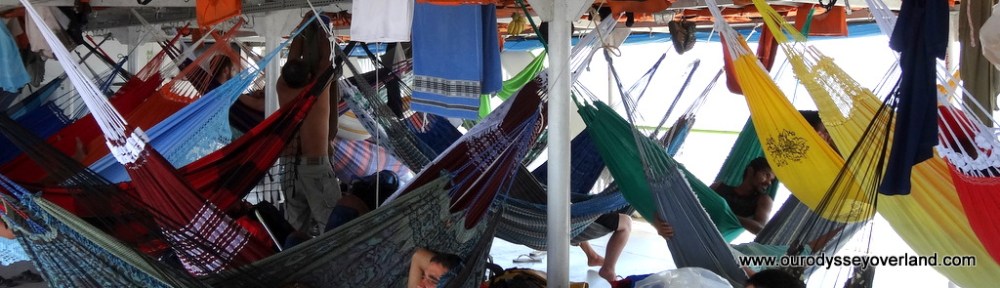

“We should all stick together & string our hammocks in a group so we’re not infiltrated by outsiders” he said. Having already caught four slow boats just to get to Manaus, the young traveller was an expert. He boarded the boat and led his small posse of 20-somethings off to fortify a prime hammock location.
But on our boat, the “Liberty Star”, we were the outsiders: we counted 9 non-locals out of about 200 passengers. Approximately half declined the luxury of the air-conditioned middle deck & opted for the open upper deck (i.e. roof but no walls). We joined them, knowing it would get hot but preferring fresh air and views to travelling in a cold box.
There were no assigned places on this boat; you simply found two hooks upon which to string up the hammock that would be your seat and bed for the next four nights. People came and went at all hours as the boat stopped at various ports along the way, so it was possible to wake up to find a new arrival swinging above, below or beside you within very close quarters. Luckily for us, it was low season and not overly crowded – we were told the boat’s maximum capacity was 700.
Facilities on board were pretty basic: the toilets emptied straight into the river which is where the shower water came from. I’d had one shower before realising this and found it difficult to have another. Our fellow passengers, however, managed to look clean & fresh, even over-the-top glamorous, every day, as only Brazilians can.
There was catering on-board, but it was expensive and we were warned prior to boarding that it was cooked in river water (not true) so were advised to self-cater. As a result we enjoyed a diet of bottled water, bread & vegemite, crackers and muesli bars for the four day journey. For every dinner, we descended to the bowels of the boat and past the engine room to ask the chef to boil water for our two-minute noodles. He seemed a surprisingly happy and accommodating guy despite the fact that he slept right beside the engine’s noise and fumes.
On our downstream path, the boat generally stuck to the faster waters in the middle of the river and it wasn’t until day three, when we entered the narrow channels of the delta, that we had close up views of the shore. Here small communities lived in simple houses, built high to avoid the flood waters and nestled in groves of tall palms. Each had a wharf and a long boat, sometimes motorised.
Learning to paddle must be a skill of equal importance to learning to walk and we saw very young children deftly handle their canoes with speed and strength, putting any elite rowing team to shame. We couldn’t work out why they rowed out to meet our boat until one of the passengers threw down a bag of chips – they were begging. The cheeky ones ignored all turbulence and safety risks to tie up to our boat, as we were moving, scramble aboard and beg in person. Whilst this was all serious business, their delight at being towed by the boat was obvious.
We reached Belem with a sense of achievement and some relief – a flat hotel mattress has never felt so good!
As for our fellow westerners, they had received poor information and were surprised to discover the trip was a four night journey, not three. Pre-booked accommodation in Belem fell by the wayside; food rations and spirits ran low. Perhaps they had caught one slow boat too many….
Some things are best explained in pictures, so take a look at the accompanying gallery with captions.


More photos of the Amazon are here.
 Our Odyssey Overland