We have made four border crossings now, each with their own quirks but all following the same basic procedure: exit ourselves (immigration) then exit the motorbikes (customs) from the current country; ride across an empty “no man’s land” between the two countries; enter ourselves (immigration) and enter the motorbikes (customs) into the new country. We proceed through the production line, going from desk to desk and emerge with a stamped passport and visa for ourselves and our bikes.
Borders always require paperwork, answers, time and patience but our experience crossing from Uruguay into Brazil pushed this to a new level because there was no production line.
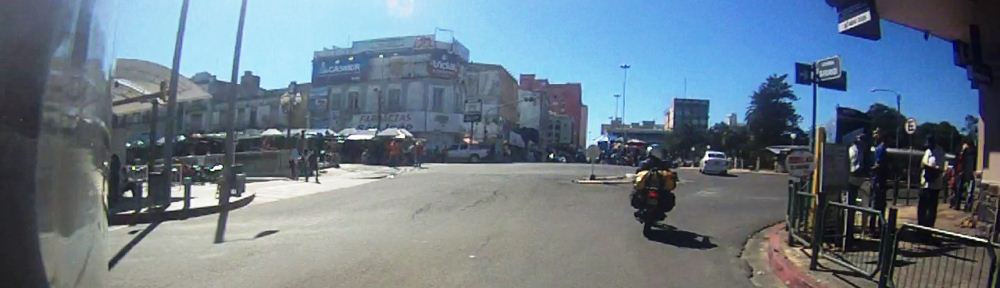
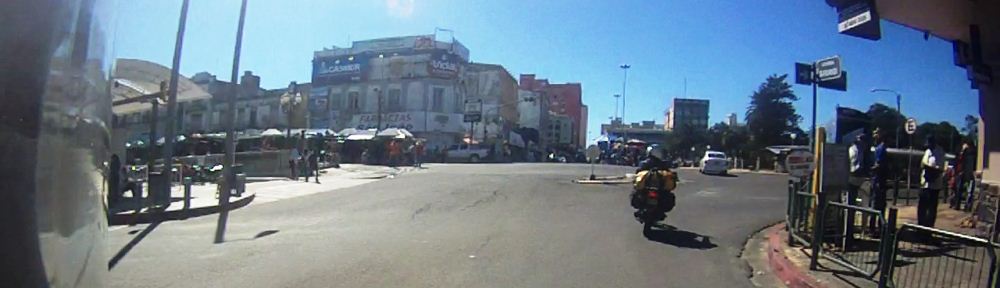
The towns of Rivera, Uruguay and Santana do Livramento, Brazil are like one big city with an “invisible” open border. That is, there is no check point, boom gate or empty void to announce your transition from one country to another. Instead, the only indication that you have crossed into another country is the shop signage: it changes from Spanish to Portuguese. Our first issue was finding the immigration and customs offices as they are located randomly within these towns.
The Uruguayan immigration was manned by Mr Stroppy. Mr Stroppy first became displeased when we revealed that we did not have the required paperwork detailing our entry into his country. Our limited Spanish infuriated him further. Apparently, the required paperwork was the ferry boarding pass that we had thrown away after the ferry ride. Of course! It was so logical that an Argentinian boarding pass would be our official entry stamp into Uruguay!! No one had told us this, so we didn’t keep it. After much huffing and muttering, he conceded to stamp us out anyway.
Across the hall was the customs desk, our next stop. At 11 o’clock in the morning it was unmanned. Feeling daring, we pushed our luck further with Mr Stroppy and asked him when it would open. A magnificent rant ensued. How should he know? Sometime in the afternoon, could be 2pm could be 3pm. He didn’t know. Why should he know?
After some quiet, he generously offered an idea: we could push our papers under the door of the customs office and be on our way. We were not keen on this idea. These are important papers to prove we have exited the country with the bikes. Pushing them under a door in the hope that the correct person would find them and do something responsible with them seemed too chancy to us. We thought we should wait and hand them over in person.
Well, Mr Stroppy was not impressed. Why did we care more about customs paperwork than his immigration paperwork? He told us repeatedly we should be grateful that he had let us through without the required documents.
After some quiet, he volunteered the information that there was another customs office in town that was open all day. We followed his vague directions to a location that was home to a customs office over one year ago. For the past 12 months it has been a community clinic for new mothers. Clearly Mr Stroppy was in no way incompetent, so we were left to assume that he knew he had sent us on a wild goose chase.
We returned to Mr Stroppy’s office, resigned to waiting indefinitely for the customs officer to show up. How surprised and relieved were we when, ten minutes later, a woman walked in confirming she was the customs officer we were waiting for. Mr Stroppy had already accosted her outside the building to moan about us, including a remark that we didn’t speak any Spanish. But this didn’t stop her talking to us in Spanish and expecting us to understand. She enthusiastically started describing beautiful music and how much she loved Andre Rieu. Oh no, we explained, we are Aust-ray-li-an. Not Austrian. From the land of the canguro (kangaroo). We hopped up and down to emphasise our meaning. She quickly changed tack and started describing how beautiful koalas are.
The lady reluctantly took up her post; unpacked her bag; told us about the excellent book she was reading about vitamins and good health and then decided to look at our paperwork. She didn’t know what to do with it so she elected to phone a friend. The friend didn’t seem to know either. In very sketchy Spanish, we finally convinced her to keep the paperwork as proof that we had taken the bikes out of the country. She folded the papers, put them to one side then proceeded to tell us that we should really learn more Spanish as it would help us have better conversations. Yep, thanks.
Two hours later we had officially left Uruguay and crossed over the invisible border into Brazil.
Despite only knowing one word of Portuguese, obrigado, entry into Brazil was relatively straight forward as the officials knew what to do with our paperwork. Again, the problem was finding them as everyone had a different opinion about where we needed to go. We zigzagged across town as we were directed from office to office until we finally found the right people.
After 25 kilometres of riding around, we finally had all our stamps and papers and were free to leave.
Only 17 more border crossings to go…..
 Our Odyssey Overland
What a wonderful story! Keep calm and carry on. Date: Thu, 16 May 2013 20:56:17 +0000 To: fdawson52@hotmail.com
So true Fiona. You just have to laugh otherwise you’d go insane!
Great story – your best post yet. Mel and I are really enjoying our vicarious journey!
Cheers
Steve
Good to hear from you. Sounds like a fabulous journey you guys are on!
Mr Stroppy! Aptly named! What a character!